
✅ THE ULTIMATE BEGINNER INVESTMENT GUIDE (EXTREMELY DETAILED, STORY-BASED & LAYMAN FRIENDLY)
If you have ever said, “I want to invest, but I don’t know where to start,” this guide is your perfect starting point.
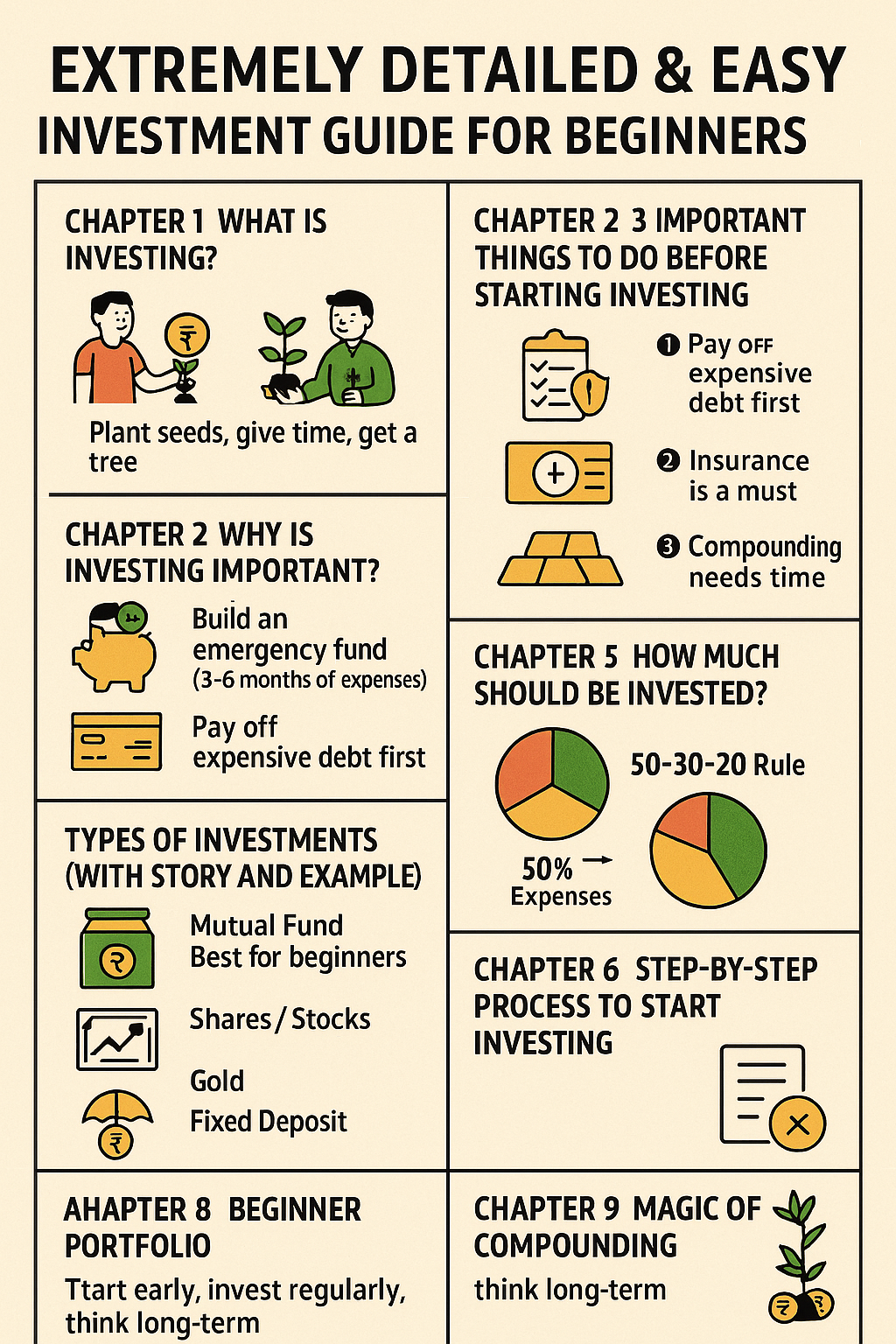
🌱 CHAPTER 1 — What Is Investing? (Explained Through a Simple Story)
Let me tell you about two friends: Rohan and Aman. Both earn ₹30,000 per month.
✅ Rohan spends everything
He believes: “Why save? I’ll enjoy today.”
He buys gadgets, parties, and takes loans.
✅ Aman invests from day 1
He sets aside ₹2,000 every month.
He follows one rule: money grows when you give it time.
After 10 years:
Rohan has nothing.
Aman has ₹3–4 lakhs.
After 20 years:
Rohan struggles.
Aman’s investments cross ₹35–40 lakhs.
Investing simply means: Putting your money to work so it grows with time.
Like a mango seed—water it, protect it, wait.
It becomes a tree that gives fruits for years.
Your money behaves the same.
🌩️ CHAPTER 2 — Why MUST You Invest? (Nobody Explains It This Way)
Most people say, “I’ll invest when I earn more.”
Reality: You earn more only if you invest.
✅ 1. Inflation: The Invisible Thief
₹1,000 in 2005 bought 25–28 litres petrol.
In 2025, it buys 3–5 litres.
Inflation eats your money silently.
Investing protects you.
✅ 2. Your Salary Won’t Grow Faster Than Your Dreams
Expenses rise yearly. Dreams grow faster.
Only investing closes the gap.
✅ 3. Emergencies Don’t Knock
Medical bills, job loss, unexpected responsibilities—savings in a jar won’t help.
Emergency funds + investments save you.
✅ 4. Compounding Needs TIME — Not Money
Aman starts at 25 (₹3k/month).
Rohan starts at 35 (₹5k/month).
At 50, Aman ends richer because compounding rewards early starters.
⚙️ CHAPTER 3 — Prepare Before You Invest (Three Must-Do Steps)
✅ 1. Build an Emergency Fund
Journey without spare tyre = risk.
Emergency fund = spare tyre.
Keep 3–6 months of expenses in a liquid fund, savings account, or short FD.
✅ 2. Clear High-Interest Loans
Bucket with a hole can never fill.
Credit cards (36–40%) + personal loans (12–18%) destroy wealth.
Clearing debt = investing.
✅ 3. Take Insurance Before Investing
Pilots use parachutes for protection.
Health insurance saves you from hospital bills.
Term insurance protects your family.
Insurance protects; investments grow.
📦 CHAPTER 4 — Investment Options Explained Like Real Life
✅ 1. Mutual Funds (Best for Beginners)
Like a school tiffin—everyone contributes, everyone benefits.
Experts manage your money.
Example:
₹500 in index fund spreads into:
Reliance, Infosys, HDFC, ICICI, TCS + others.
Best for beginners:
⭐ Index Fund (safest + low cost)
⭐ Large Cap Fund
⭐ Hybrid Fund
Average returns: 10–14%
✅ 2. Direct Stocks (Shares)
Owning a stock = owning a part of a shop.
Example:
₹10,000 in Asian Paints in 2000 → ₹9–10 lakhs today.
Start with Nifty 50 companies.
Avoid penny stocks and tips.
✅ 3. Gold (A Safety Shield)
Gold rises in crises.
Best options: SGB, Gold ETF, Digital Gold.
✅ 4. Fixed Deposits (FD)
Safe and stable.
Good for short-term, emergency funds, seniors.
Not ideal long-term.
✅ 5. Real Estate
Like a coconut tree—slow but rewarding.
Good for rental income and long-term value.
Bad for liquidity and high entry cost.
🧮 CHAPTER 5 — How Much Should You Invest? (Example Included)
Use the 50-30-20 Rule:
50% Needs | 30% Wants | 20% Investments
Example (₹25,000 salary):
₹12,500 Needs
₹7,500 Wants
₹5,000 Investments
Even ₹500/month is enough to begin.
🚀 CHAPTER 6 — Exact Step-by-Step Process to Start Investing
✅ Step 1 — Open a Demat Account
Groww, Zerodha, Upstox
✅ Step 2 — Set Goals
Short, Medium, Long Term
✅ Step 3 — Map Goals to Investments
| Goal | Best Investment |
|---|---|
| 1–2 years | FD / Liquid Fund |
| 3–5 years | Hybrid Fund |
| 5–15 years | Equity Mutual Fund |
| 10–20 years | Stocks |
✅ Step 4 — Start SIP
Invest monthly.
✅ Step 5 — Don’t Panic During Market Falls
Buy more, stay invested, don’t stop SIP.
🔥 CHAPTER 7 — Beginner Mistakes (Real Examples)
❌ Rohan bought penny stocks → Lost 80%
❌ Meera stopped SIP → Missed compounding
❌ Rahul followed Telegram tips → Lost money
❌ Ishan invested short-term money → Forced to book loss
📘 CHAPTER 8 — The Perfect Beginner Portfolio
✅ 40% — Index Fund
✅ 30% — Large Cap Fund
✅ 10% — Gold
✅ 10% — FD / Liquid Fund
✅ 10% — Blue-chip Stocks
Balanced and growth-oriented.
💡 CHAPTER 9 — The Magic of Compounding (Story-Based)
A bamboo seed shows no growth for years, but roots strengthen underground.
In the 5th year, it shoots up 90 feet in six weeks.
Investing is the same—slow early, magical later.
✅ FINAL MESSAGE — Anyone Can Become Wealthy
You don’t need high income, high knowledge, or perfect timing.
You only need time, consistency, patience, discipline, and a simple plan.
Stay invested 10–20 years and wealth follows automatically.
🔒 Disclaimer: My Finance Guide provides educational content only. We are not SEBI-registered advisors, and none of the information here should be considered financial advice. Readers are encouraged to consult licensed professionals before making investment decisions.