
Building a ₹1 lakh dividend portfolio is one of the smartest wealth-building moves you can make if your goal is to generate steady passive income while keeping risk under control.
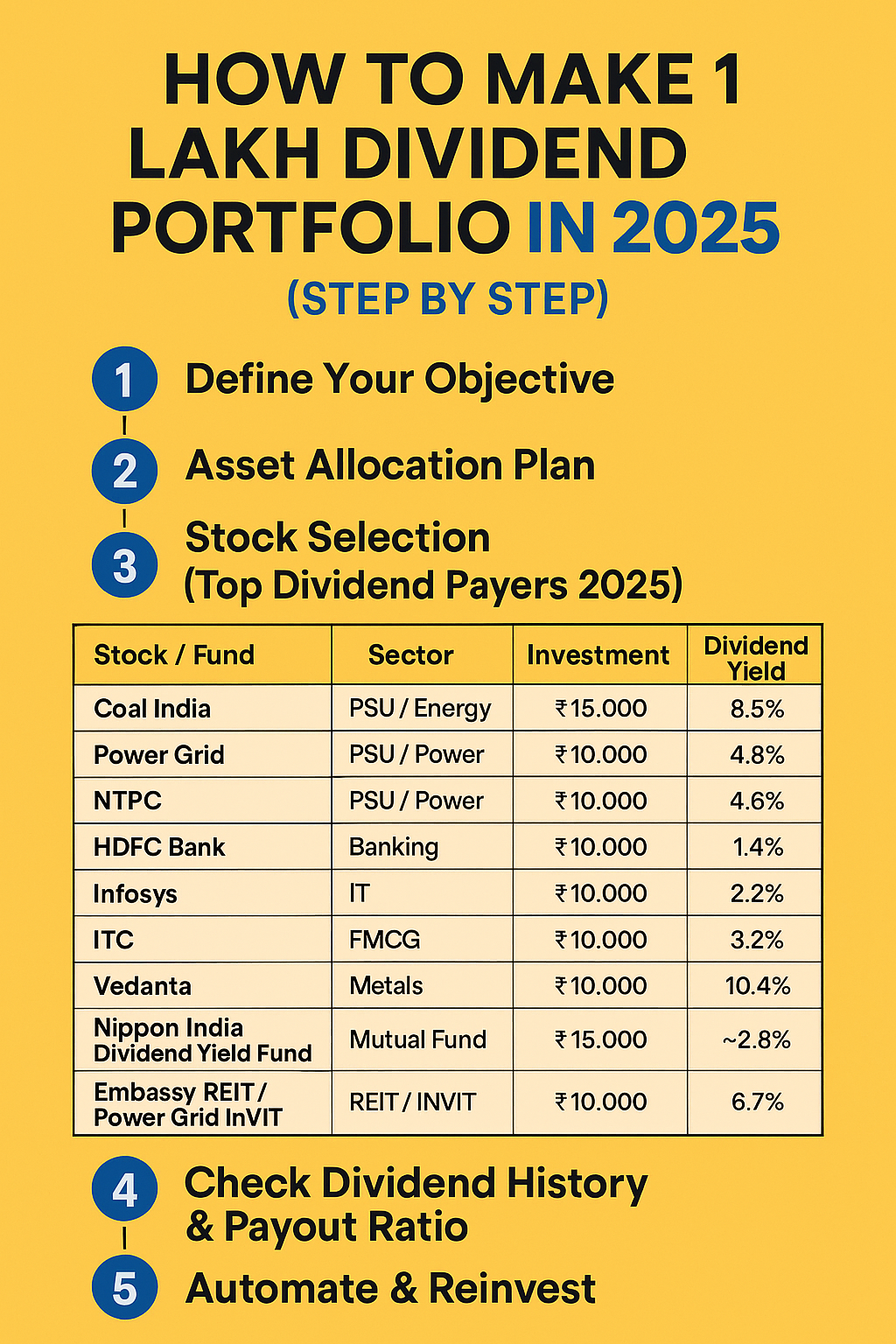
Let’s go step-by-step, keeping the 2025 Indian market context (current interest rates, valuations, and dividend trends) in mind.
🧭 Step-by-Step Guide: Build a ₹1 Lakh Dividend Portfolio (2025 Edition)
🪙 Step 1: Define Your Objective
Goal:
To generate steady annual dividend income and moderate capital appreciation with minimal volatility.
Target yield:
~4–6% average dividend yield.
That means from ₹1,00,000 invested, you can expect ₹4,000 – ₹6,000 per year in dividends (₹330–₹500/month average).
📊 Step 2: Asset Allocation Plan
| Asset Class | Allocation | Reason |
|---|---|---|
| High dividend PSU stocks | 40% | Reliable payout, regular dividends |
| Blue-chip private companies | 35% | Consistency + growth |
| Dividend-oriented mutual fund / ETF | 15% | Diversification |
| REITs / InvITs | 10% | Quarterly income + inflation hedge |
🧱 Step 3: Stock Selection (Top Dividend Payers 2025)
Let’s shortlist based on 3 key filters:
- Dividend yield > 3%
- Consistent payout in last 5 years
- Strong fundamentals & low debt
💼 Suggested Sample Portfolio (₹1 lakh)
| Stock / Fund | Sector | Allocation (₹) | Dividend Yield (%) | Remarks |
|---|---|---|---|---|
| Coal India | PSU / Energy | ₹15,000 | 8.5 | Strong cash flow, regular special dividends |
| Power Grid Corp. | PSU / Power | ₹10,000 | 4.8 | Dividend aristocrat |
| NTPC Ltd. | PSU / Power | ₹10,000 | 4.6 | Stable, regular payout |
| HDFC Bank | Banking | ₹10,000 | 1.4 | Lower yield but steady growth |
| Infosys | IT | ₹10,000 | 2.2 | Consistent semi-annual dividend |
| ITC Ltd. | FMCG | ₹10,000 | 3.2 | Cash-rich, reliable |
| Vedanta Ltd. | Metals | ₹10,000 | 10+ | High yield but cyclical — keep exposure limited |
| Nippon India Dividend Yield Fund | Mutual Fund | ₹15,000 | ~2.8 | Diversified exposure |
| Embassy REIT / Power Grid InvIT | REIT/InvIT | ₹10,000 | 6–7 | Quarterly income stream |
Total Investment = ₹1,00,000
🔍 Step 4: Check Dividend History & Payout Ratio
Before investing, check:
- Dividend per share (DPS) trend for 5 years
- Payout ratio (prefer 30–70%)
- Consistency: Avoid one-time special dividend traps
Use sources like Moneycontrol, Screener.in, or Trendlyne to verify.
💰 Step 5: Automate & Reinvest
- Use a broker app with dividend reinvestment or SIP facility.
- Whenever dividends are credited, reinvest them in the same stock or a high-yielding ETF.
- Compounding dividends over 5 years can boost your portfolio by 20–30%.
🧮 Step 6: Expected Annual Income (2025)
| Source | Investment | Yield | Est. Annual Dividend |
|---|---|---|---|
| PSU basket | ₹35,000 | 6.0% | ₹2,100 |
| Blue-chip basket | ₹30,000 | 2.5% | ₹750 |
| MF/ETF | ₹15,000 | 2.8% | ₹420 |
| REIT/InvIT | ₹10,000 | 6.5% | ₹650 |
| Total ≈ ₹1,00,000 | 4.0–4.2% avg | ₹3,900 – ₹4,200 p.a. |
🧩 Step 7: Review Annually
Rebalance every year:
- Sell if dividend cut or debt rises sharply
- Add if company improves payout or valuation corrects
- Track Dividend Yield % vs 10-yr G-Sec Yield
🧘♂️ Step 8: Tax Considerations
- Dividends are taxed as per your income slab (since FY 2020–21).
- For long-term holding, focus on total return (dividend + capital gain) rather than yield alone.
- Use a low-cost Demat + mutual fund platform to avoid unnecessary fees.
⚙️ Step 9: Optional Add-Ons (for Monthly Income)
If your goal is monthly cash flow, consider:
- REITs / InvITs (quarterly distributions)
- Monthly Dividend Mutual Funds (e.g., Franklin or ICICI Prudential Dividend Yield)
- STP from a debt fund (systematic transfer plan to equity or bank account)
📅 Step 10: Growth Plan — Next 5 Years
| Year | Additional Investment | Target Corpus | Expected Annual Dividend |
|---|---|---|---|
| 2025 | ₹1 lakh | ₹1 lakh | ₹4,000 |
| 2026 | +₹50,000 | ₹1.5 lakh | ₹6,000 |
| 2027 | +₹50,000 | ₹2.0 lakh | ₹8,000 |
| 2028 | +₹50,000 | ₹2.5 lakh | ₹10,500 |
| 2030 | — | ₹3.0 lakh+ (with reinvestment) | ₹13,000 – ₹15,000 |
✅ Summary Checklist
| Step | Action | Done |
|---|---|---|
| Define income goal | ₹4k–₹6k/year | ☑️ |
| Allocate across sectors | PSU + Blue-chip + REIT + MF | ☑️ |
| Verify dividend history | 5-year track record | ☑️ |
| Diversify 8–10 holdings | No overconcentration | ☑️ |
| Automate reinvestment | Compounding | ☑️ |
| Annual review | Rebalance | ☑️ |
🔒 Disclaimer: My Finance Guide provides educational content only. We are not SEBI-registered advisors, and none of the information here should be considered financial advice. Readers are encouraged to consult licensed professionals before making investment decisions.